Sometimes I think love is less about finding someone and more about confronting the parts of yourself you spend most of your life trying to avoid.
Psychology didn’t make love simpler for me, it made it heavier. Because once you understand attachment, trauma responses, projection, defense mechanisms… you start seeing how much of love isn’t pure. It’s history repeating itself in new faces. It’s longing shaped by absence. It’s recognition that feels like fate but might just be familiarity.
And familiarity isn’t always safe.
People say they want to be seen, but I’m not sure that’s true. I think most people want to be seen in ways that don’t threaten their self-image. Real seeing, psychological seeing, is uncomfortable. It means someone notices your contradictions, your avoidance, the moments when you pull away just when closeness becomes real.
And maybe the hardest part is recognizing those patterns in yourself.
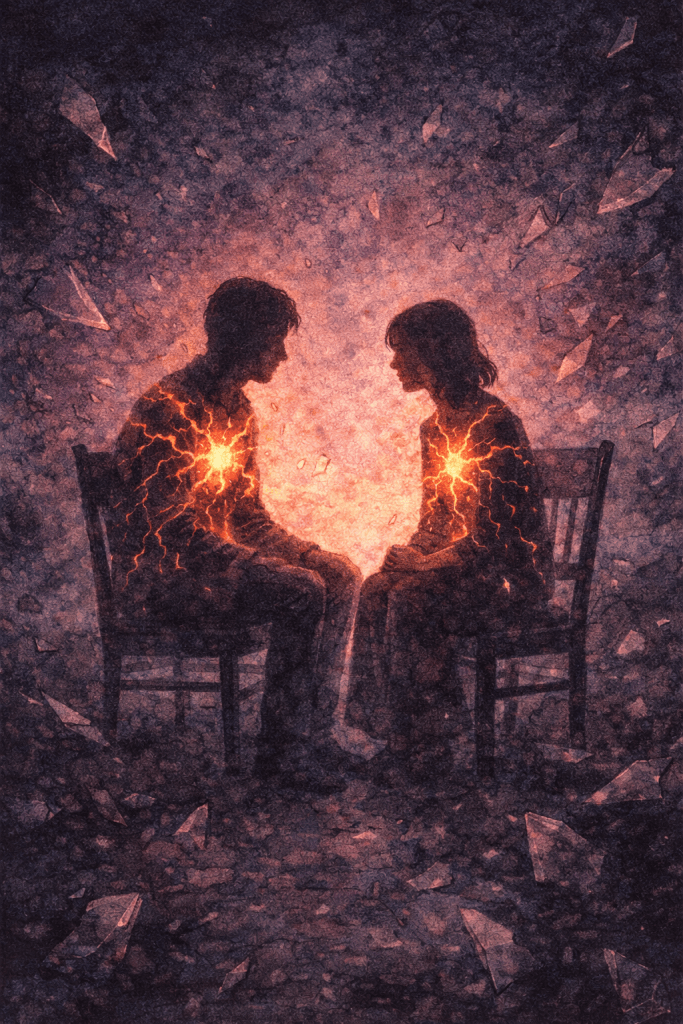
There’s a quiet violence in vulnerability. You give someone access to your internal world, your fears, your hopes, your raw thoughts, and suddenly they have the power to change how you feel about yourself. Love creates witnesses to your inner life, and that’s terrifying because witnesses can leave.
I’ve noticed how love activates old fears that feel irrational until you trace their roots. Why certain silences feel unbearable. Why distance feels like rejection even when logic says otherwise. Why reassurance works temporarily but never fully dissolves the deeper question: am I safe here?
Psychology tells us that attachment bonds mirror early relational experiences, but knowing that doesn’t stop the ache when something feels unstable.
There’s also a darker truth people don’t like to admit, sometimes we are drawn to dynamics that challenge us because they feel emotionally alive. Calm can feel unfamiliar. Healthy can feel boring when your nervous system has learned to equate intensity with meaning.
So we chase depth, but sometimes what we’re chasing is activation.
And awareness doesn’t always save you. You can recognize a pattern and still feel pulled toward it. Insight and impulse don’t always align. The mind says, this is familiar for a reason, while the body whispers, but it feels real.
I think about how love changes perception. How we project potential onto people and fill in emotional gaps with hope. It’s not delusion exactly, it’s co-creation. We help shape the version of someone we fall for, and then we grieve when reality refuses to match the internal narrative we built.
And yet, despite all this awareness, the longing remains.
The desire to merge without disappearing. To be understood without explaining every detail. To feel chosen not because you’re easy to love, but because someone has seen the difficult parts and stayed anyway.
Sometimes I wonder if love is fundamentally an existential risk, the willingness to let another person influence your internal stability. To allow their presence to calm you and their absence to disrupt you.
That’s power.
Maybe that’s why people build defenses. Independence becomes armor. Analysis becomes distance. If you can understand love, maybe you don’t have to feel it as deeply.
Except that never works for long.
Because underneath all the theory and insight is something simpler and more unsettling: the human need to connect deeply enough that it changes you.
And change always carries loss.
You lose old versions of yourself. Old beliefs. Old emotional defenses. Love asks you to evolve or retreat, and sometimes both feel terrifying.
The darkest realization might be this:
Love doesn’t guarantee safety. It only guarantees significance.
And yet we keep choosing it.
 Probably Overthinking
You must be logged in to post a comment.